


Here, we propose a 𝗛𝘂𝗺𝗮𝗻-𝗙𝗶𝗿𝘀𝘁 𝗔𝗜 𝗔𝗱𝗼𝗽𝘁𝗶𝗼𝗻 𝗙𝗿𝗮𝗺𝗲𝘄𝗼𝗿𝗸 built on one simple principle: 𝗽𝗲𝗼𝗽𝗹𝗲 𝗳𝗶𝗿𝘀𝘁. We believe AI should strengthen human capability, not replace human judgement or accountability. Our AI agents are therefore designed as assistants to humans, and we call them 𝗗𝗶𝗴𝗶𝘁𝗮𝗹 𝗘𝗺𝗽𝗹𝗼𝘆𝗲𝗲𝘀.
By Rejikumar Nair
In 2018 I wrote two short pieces. One spoke about the thinking and responsibility behind AI adoption: look at the long-term return before adopting any new technology, avoid bragging rights, and remember that humanity is at stake. I called it algorithmic intelligence, not artificial intelligence. The other said that within five to ten years, a handful of technology giants would control the game while governments ran on autopilot. Both articles are still on my LinkedIn profile today, exactly as I published them, without a single edit.
Eight years later, here we are. So this is not an “I told you so”. It is a “here is the way forward”.
AI is not the problem. AI is a good thing. A good thing was handed to a world in a hurry, and it was implemented in a hurry. Now all of us are doing patchwork in front of a public that has grown sceptical. That can be fixed, and the fix starts with one question: who comes first? Is an AI agent something you set loose to replace a person, or an assistant that works for a person?
First, clear the confusion
Look at the last fifty years. It began with the calculator and the personal computer, tools that arrived slowly enough for people to absorb. Then the pace changed. Operating systems came in versions you had to move to. The dot-com rush was followed by ERP, mobile apps, the cloud, big data, the Internet of Things, blockchain, fintech, regtech, robotic process automation, virtual reality, NFTs and the metaverse. Then came the AI partnerships worth billions, and now quantum is warming up backstage. Some of these waves changed the world. Some passed once the money had been made. Each landed before the last was understood.
So here is the direction: you do not have to surf every wave. A confused customer is a profitable customer, so stop being one. You cannot negotiate with a supplier whose product you do not understand. Understand first, then buy.
And use this simple test. One day a technology advisor tells you to move everything to the cloud, and you do. Twelve years later the same advisor is back, helping you return to on-premise systems and speaking warmly about decentralised data and servers kept inside your own country. Before you sign again, ask them to explain their viewpoint then and their viewpoint now. A good advisor will have a good answer.
To the big players and the loudest voices in technology: moving billions from one company to another and back in a different form is not progress. Market capitalisation is a scoreboard, not a purpose. Point that money and that talent at people, and the scoreboard will follow.
A word to governments
You do not need to be technologists. You need to ask what this does to people, to society and to the next generation, and then act on the answer.
Two things to do. First, finish what you start. The developing world has many AI strategies and guidelines, mostly voluntary, and very little that is completed and executed. The UN’s own trade and development body reported in 2025 that 118 countries, mostly in the Global South, are absent from the major AI governance discussions, while AI could affect 40% of jobs worldwide. Take your seat in that room.
Second, write the policy nobody has written yet: how much of a job a human should do, and how much a machine may do. I have not seen one anywhere. The “Big Ns” are moving faster and faster towards the machines, so somebody needs to start counting what is left for people.
Global institutions, this moment is exactly what you were built for. Speak up.
We already know how to do this
Here is the good news. We have done it properly before. Mobile technology reached the world through shared standards. Competitors sat in the same rooms and agreed on common rules before they went to market. Early pioneers of the mobile internet worked with an “unwired planet” mindset: connect everyone, and make sure it works across everyone’s devices. The open smartphone platform that followed was launched in 2007 through an alliance of handset makers, carriers, chip makers and software companies, built around open standards. It was not perfect, but the industry agreed on common ground first.
With AI that step was skipped. Connect the dots: a responsible leadership group can still sit in one room and do it. It is late, not too late.
Point it at the real world
While billions circulate among the same few names, children still work on the cocoa farms of West Africa. The industry promised to end this in 2001, the deadlines moved again and again, and a 2020 study funded by the US Department of Labor still counted 1.56 million children in child labour in cocoa in just two countries. Basic life infrastructure in much of Africa, and even in parts of the countries that host these companies, remains painfully inadequate.
A technology that can write poetry in a second has yet to meaningfully change this reality. So here is where to aim it. That is where this world should go.
Our formula, free to copy
I do not believe in raising a concern without bringing an answer. At SkilledX we built something anyone can copy.
Our policy is people first. So for us an AI agent is not something set loose to act on its own. It is an assistant to a human being, and we call it a Digital Employee, or DE. It listens carefully and helps a person finish their task.
Remember the calculator. It has a small arithmetic brain. It never replaced the accountant; it made the accountant faster. The only difference is that a DE has logic and reasoning where the calculator has arithmetic. It is still in a human hand.
Think of a loyal puppy at home, or a bright, charismatic young colleague at work who makes you better at your own job. That is the relationship. AI is not replacing people. It is strengthening them and improving their skills.
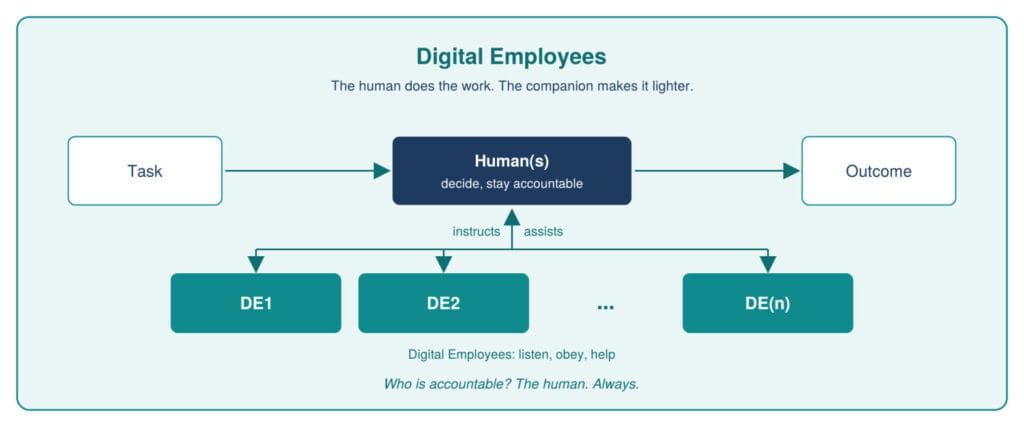
The Digital Employee model: human(s) decide and stay accountable; DE1, DE2 … DE(n) listen, obey and help.
Autonomous agent or Digital Employee: what is the difference?
In the autonomous agent model, the task goes to the machine. The machine decides and acts, and a human is left to watch and clean up. Ask who is accountable for the outcome and nobody can answer clearly.
In the Digital Employee model, the task goes to the human. The DE sits beside that person, takes instructions, and does the heavy lifting: finding, reading, preparing, drafting, reminding. The customer, the citizen, the person in need still deals with a human being.
So, to the “Big Ns” pumping billions into autonomous agents: pump that money into the humans who helped you reach where you are today. Grow, and let them grow with you.
Five rules of a Digital Employee, and how we built them
Rules on paper are easy. Each rule below is followed by what we actually built into the platform that runs our DEs.
- The human decides and stays accountable. A named person owns the outcome, never the DE. Conversations, business rules and connections stay on the company’s side, under the company’s control.
- It listens and obeys. A DE acts on instruction and does not set its own goals. Every capability comes from one central library, so a DE cannot pick up a new power by itself.
- It works from your own organisation’s knowledge. It answers from your documents and rules, not from guesswork. This is your institutional memory: the single place where your organisation solves its jigsaw puzzle.
- It keeps only what it needs. A DE’s memory holds only what the job requires. We offer a proper retention timeframe and an audit trail: chats and temporary data are cleared after the set period, and our design rule is permanent deletion, not a hidden archive. Client data is protected by NDA and is never used for promotion.
- The goal: eight hours become four. This is our design objective, not a guarantee: to take as much as half the load and give those hours back to the human, for family, for learning, for better work. If the primary AI model fails, the DE moves to a fallback model, so the person depending on it is not left stranded.
Why this is the model for the next generation
A young person entering the workforce today is being told that a machine will take their job. Under the DE model, they are told something different: you will have a companion designed to carry a large share of your load, and you will remain the one who thinks and decides. Skills grow instead of fading.
There is no secret in this. Technology is nobody’s ancestral property. Take the formula and use it.
A request to responsible people
For the next few ripples of this technology, world leadership must learn, and then act. If you understand it, come forward and help the older generation of leadership understand what they are signing. Do it kindly. Human existence is at stake, and that is reason enough to work together.
Here is my strongest observation. The leaders who held the most powerful seats in technology when this wave began were among the very few people who could have called everyone into one room. They chose to race. One of them said openly that he wanted the world to know his company had made a rival “dance”. Another called publicly for a pause in AI development, then launched his own AI company within months. Voluntary safety commitments followed, but they came after the products were already in the market, and none of them is binding. That is why a new “unwired planet” moment never happened for AI. It was not a failure of technology. It was a choice of leadership, and a choice can still be made differently.
The saddest part, in my view, is that the Big Four, the very firms paid to advise everyone else, appeared to be following the race rather than shaping it. Ironically, they became part of the “cockroach story” Sundar Pichai once told, the one that teaches us to respond and not react: they reacted before they fully understood what was happening. They then began investing heavily, effectively paying supersonic-jet prices for a family car.
My advice is the same as it was in 2018: do responsible things, and lead by example. Put the human first, and then show the world how it is done.
How we can help you
We can help you define a human-first work culture and adopt Digital Employees inside it. Done this way, the aim is a better return on investment, fewer errors, and a workplace where your people, your customers and you are all happier.
We lead by example here too. Through Templifyr for Good, our CSR programme, we offer Digital Employees free of cost to NGOs and government agencies. When someone in need calls for help, a human answers and the DE stands beside that human, so they never have to say “I don’t know.” It is a small hand, but it is ours, and we are extending it.
It is a matter of thinking. We learned to work with the calculator, then the phone, then the computer. Now we are learning to work with AI agents. The difference is that these can listen to us and work alongside us. So use them wisely.
There is a transformation point in every organisation, where your people and your technology meet your revenue. From that point comes the next step, towards a sustainable existence. Do not jump the gun and adopt anything without knowing where your transformation point is.
Start with one question before your next AI purchase: who in my organisation will this make stronger, and who stays accountable for the result? If you cannot answer it, wait.
If you would like to work through that question with us, write to contactus@skilledx.in or call +91 81389 48284.
Sources: AI governance and jobs figures from UN Trade and Development (UNCTAD), Technology and Innovation Report 2025. Child labour figure from the NORC at the University of Chicago report for the US Department of Labor, October 2020, as reported by ConfectioneryNews.
Earlier pieces on the same subject, AI and its responsible adoption, unedited since publication: Algorithmic Intelligence Vs Intelligence (October 2018) and An unbiased middleman approach on future technologies (December 2018).

ABOUT THE AUTHOR
Rejikumar Nair
Head of AI, Automation & BPO, SKILLEDX
Rejikumar Nair is the Head of AI, Automation & BPO Operations at SkilledX, where he also leads the SkilledX Insights editorial team. With 15 years of experience at a Big 4 consulting firm, Nair has built extensive expertise in digital transformation and process automation across various business functions.
About SkilledX
SkilledX is an outsourcing partner delivering specialised services across three core pillars: Business Process Outsourcing, ERP Solutions, and Ethics & Compliance. We partner with corporations, growing businesses, SMEs, and startups across diverse industries, offering tailored expertise, process efficiency, and cost-effective scalability. From ERP implementation to compliance management and back-office operations, we provide end-to-end support designed to drive business growth and operational excellence.
About Templifyr
Templifyr is part of SkilledX Business Process Outsourcing Services LLP and forms the AI and automation foundation behind IndOS. Templifyr is an enterprise AI and automation platform combining a Digital Workforce powered by Agentic AI, purpose-built AI Applications and enterprise Automation. It helps organizations embed intelligence into real business processes, connect existing systems and scale execution with greater control, consistency and governance.
Our Vision: transformify.xyz
Contact:
Email: contactus@skilledx.in
Tel:+918138948284 (Sales)
WhatsApp: https://wa.me/918138948284 (Sales)
Website: https://skilledx.in
Free Consultation: https://skilledx.in/wp/meeting/
Leave a Reply
You must be logged in to post a comment.