


The hybrid ERP approach enables SMEs to achieve faster implementation, lower costs, and higher user adoption by separating transactional complexity from user experience. This modular, flexible system improves both productivity and communication by offering specialized, user-friendly tools while ensuring seamless integration across business functions.
How strategic system design delivers superior outcomes for growing enterprises
Enterprise resource planning has reached an architectural inflection point. For three decades, the industry pursued integration through consolidation—one database, one vendor, one interface for everything. The hybrid ERP architecture challenges this orthodoxy with a counterintuitive insight: properly separated systems with intelligent integration outperform monolithic platforms across virtually every dimension that matters.
Organizations implementing hybrid architectures report implementation timelines sixty to seventy percent shorter, user adoption rates twice as high, and operational efficiency gains that compound over time. The approach succeeds because it aligns system design with fundamental organizational realities rather than forcing business operations into predetermined software paradigms.
The Architectural Foundation: Separation of Concerns
The hybrid ERP philosophy rests on separation of concerns borrowed from software engineering. Backend transactions demand data integrity, audit trails, and regulatory compliance. Frontend interactions require intuitive experiences, mobile accessibility, and consumer-grade design. Forcing these divergent requirements into one system architecture creates uncomfortable compromises.
The hybrid approach establishes clear boundaries. The transactional core functions as the system of record—handling structured business logic, financial accounting, inventory transactions, and regulatory compliance. This layer prioritizes data integrity over user experience, serving trained professionals working from office environments.
The engagement platform functions as the system of interaction—managing people, relationships, and collaboration. This layer prioritizes user experience over transactional complexity and mobile-first design, serving everyone from field workers to executives.
Between these layers sits the integration fabric—API connections, real-time synchronization, and workflow automation that makes the separation invisible to end users. When properly designed, employees experience unified systems despite distinct underlying platforms.
Why Monolithic Systems Fail the Hybrid Organization Test
Modern organizations are inherently hybrid. A construction company with one hundred employees might have fifteen office staff and eighty-five field workers. Field workers need GPS-based attendance tracking and simple production logging—not access to general ledgers. Forcing them into ERP mobile apps designed as scaled-down desktop interfaces virtually guarantees poor adoption.
Traditional ERP systems emerged when professional staff worked from offices using desktop computers. That homogeneous context no longer exists. Today’s workforce spans from laborers with smartphones to accountants with specialized training, each requiring fundamentally different interfaces.
The monolithic approach also struggles with innovation velocity. Collaboration tools evolve rapidly as consumer expectations shift. In monolithic architectures, these capabilities arrive slowly because one vendor must develop everything. Hybrid architectures adopt best-of-breed innovations as specialized providers release them.
Use Case
The Construction Industry Architecture: Design Excellence in Practice
This use case demonstrates how hybrid ERP principles apply to a construction company with 100 employees—15 office staff, 10 supervisors, and 75 field workers. The company tracks projects using detailed bills of quantities, monitors daily production metrics, calculates performance-based wages, manages complex procurement, and ensures regulatory compliance.
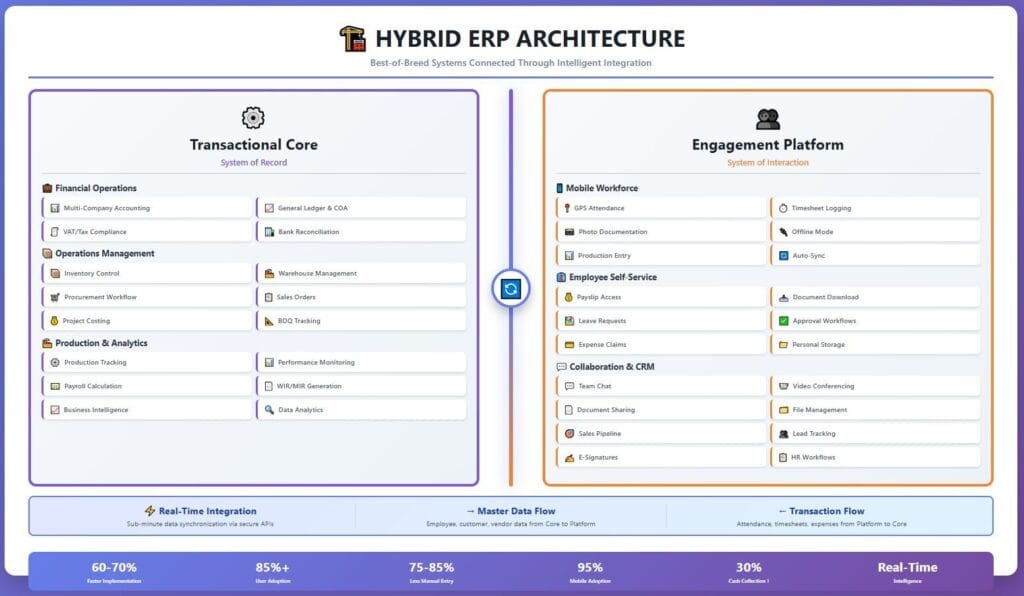
The Transactional Core handles financial integrity through multi-company accounting, complete procure-to-pay workflows, and inventory management. Custom modules track bills of quantities, monitor production, automate report generation, and calculate performance-based payroll. This layer is optimized for finance teams, project accountants, and procurement specialists, offering precise, power-user interfaces.
The Engagement Platform delivers a consumer-grade experience. Employee self-service portals display payslips and documents. Field workers use mobile apps for GPS attendance tracking, simple offline production logging, and photo uploads for progress tracking. Team communication, document management, and HR workflows (including e-signatures) complete the user experience layer.
The Integration Fabric connects everything seamlessly. Employee data syncs with the engagement platform, attendance and timesheet data feeds payroll, and production logs update project costs automatically. Payslips appear in mobile apps, leave requests update absence records, and all data is synchronized in real-time with sub-minute latency.
The Transformation is Measurable:
- Manual data entry drops by 75%.
- Monthly close cycles shrink from 15 days to just 3.
- Field worker adoption jumps to 95%, compared to 0% for traditional ERP mobile apps.
- Project profitability shifts from retrospective monthly reviews to real-time monitoring.
- Cash collection cycles improve by 30%, thanks to faster report generation.
The Performance Advantage: Quantifiable Results
Implementation Velocity: Traditional ERP deployments extend twelve to eighteen months. Hybrid implementations complete in four to six months—a sixty to seventy percent reduction. This acceleration comes from configuring proven systems rather than extensive customization.
User Adoption: Traditional ERP achieves thirty to forty-five percent utilization. Hybrid approaches exceed eighty-five percent because purpose-built interfaces serve specific user needs. Field workers receive mobile applications designed for field use. Office staff access power tools without compromising for casual users.
Operational Efficiency: Manual data entry decreases seventy-five to eighty-five percent through integration. Monthly close cycles compress from ten to fifteen days down to two to three. Report generation transforms from days of compilation to instant dashboard access.
Real-Time Intelligence: Management sees live project profitability, cash flow, and resource utilization—not last month’s reports. Production variances surface immediately. Material shortages trigger procurement before work stops. Cash collection improves thirty percent through faster work inspection report generation.
Core Architectural Principles
Separation of Concerns maintains clear boundaries. The transactional core handles structured business logic, transactions, and compliance. The engagement platform handles people, relationships, and collaboration. This separation eliminates complexity and maximizes effectiveness.
Single Source of Truth prevents data chaos. The transactional core functions as the system of record for master data and financial truth. The engagement platform provides user interfaces. Data flows unidirectionally, ensuring consistency without duplication.
Mobile-First Philosophy serves distributed workforces. Field workers—often eighty percent of employees—receive best-in-class mobile experiences, not compromised ERP apps. Office staff access powerful desktop interfaces when appropriate.
Real-Time Intelligence drives operational excellence. Webhooks and sub-second synchronization enable real-time decision making. Management accesses live data, not periodic reports. Automated alerts trigger on exceptions.
Security by Design protects the enterprise. Role-based access, field-level encryption, audit trails, and compliance controls integrate into workflows from inception, not bolted on afterward.
Scalability and Future-Proofing enable growth. Architecture supports thirty to three thousand users without redesign. Adding entities, countries, or business lines occurs incrementally. Open-source components eliminate vendor dependency.
Innovation Beyond Traditional ERP
Construction-Native Intelligence goes beyond generic project management. Bill of quantities-driven workflows understand retention payments and variation orders. Production tracking knows square meters, not just hours. Work inspection reports generate automatically from transactional data. The system speaks construction language.
Production-Based Payroll revolutionizes workforce economics. Workers receive pay per square meter completed, not fixed salaries. Automatic bonus calculations reward top performers. GPS-verified attendance eliminates time theft. Production transparency drives twenty percent productivity gains.
Payment Velocity Optimization improves cash flow. Work inspection report generation drops from two hours to five minutes. Faster client reporting enables faster payment applications. Cash collection cycles improve thirty percent. Working capital optimization through automation provides financial benefits beyond operational efficiency.
Dual-Persona UX Design maximizes adoption. Office staff receive power-user ERP interfaces. Field workers receive consumer-grade mobile apps. Right interface for right user drives ninety-five percent adoption versus forty percent for traditional ERP mobile applications.
The Strategic Advantage
Hybrid architecture provides sustainable competitive advantages. Organizations with modern systems bid more competitively through lower costs. They handle complex projects because systems manage complexity without proportional overhead. They scale faster because technology enables rather than constrains growth. They attract better talent who prefer modern tools.
The architecture provides strategic flexibility. Market pivots don’t require reimplementation. New business models can adopt different tools. Geographic expansion doesn’t force uniform technology on diverse markets. Innovation access accelerates as specialized platforms incorporate advances faster than monolithic vendors.
Implementation Methodology
Begin by identifying natural boundaries in operations. Which functions require transactional integrity versus user experience priority? Which users are trained professionals versus need consumer-grade simplicity? These boundaries guide architectural decisions.
Select components based on best-of-breed capability within domains. Choose transactional cores for strength in accounting and compliance. Choose engagement platforms for excellence in user experience and mobile design. Design integration deliberately with clear systems of record for each data type.
Implement in phases delivering value early. Start with transactional core for back-office operations. Add engagement platform for high-impact user populations. Build integration progressively. This reduces risk, builds momentum, and enables course correction.
Conclusion
The future of enterprise systems belongs to composable architectures where best-of-breed components work seamlessly together. Organizations embracing hybrid approaches position themselves at the leading edge of fundamental industry transformation. The question isn’t whether to adopt hybrid architecture—it’s when to start and how to execute effectively.
Partner with SkilledX to build a custom hybrid ERP architecture that addresses your specific business needs. Our implementation approach optimizes workforce productivity, enables seamless cross-functional communication, and transforms your organization’s operational excellence.
About This Analysis
This article examines hybrid ERP architecture based on real-world implementations across construction, manufacturing, and professional services. The approach represents proven design patterns validated through production deployments.

ABOUT THE AUTHOR
Rejikumar Nair
Head of AI, Automation & Marketing, SKILLEDX
Rejikumar Nair is the Head of AI, Automation & Marketing Operations at SkilledX, where he also leads the SkilledX Insights editorial team. With 15 years of experience at a Big 4 consulting firm, Nair has built exceptional expertise in digital transformation and process automation across various business functions.
About SkilledX
SkilledX is a trusted creative partner for businesses looking to optimize operations through outsourcing. We help companies reduce costs across creative needs—from branding and design to marketing materials, thought leadership, websites, and digital automation. Led by experienced professionals, we deliver high-quality, timely work that saves our clients more than 35% in costs while strengthening our clients’ brand recognition.
Working remotely with clients globally, we specialize in comprehensive creative solutions, including proposals, investment & strategy presentations, marketing materials, insights, white papers, and thought leadership content. Our web development expertise spans corporate websites, e-commerce platforms, portals, intranets, and UI/UX design, ensuring our clients have a strong digital presence.
We also deliver custom e-learning solutions to help organizations enhance training and development initiatives. As innovation leaders, we’ve developed Templifyr our AI-powered platform that revolutionizes tender and proposal management. Through our tender due diligence service ‘RFP Simplified’, TAPE (Templifyr AI Prompt Engine), and DIA (Document Intelligent Assistant), we help our clients make informed decisions about tender participation and create winning proposals efficiently.
Our vision is to become the most valued creative outsourcing partner worldwide.
Contact:
Email: contactus@skilledx.in
Tel:+918138948284 (Sales)
Whatspp: https://wa.me/918138948284 (Sales)
Website: https://skilledx.in
Free Consultation: https://skilledx.in/wp/meeting/
Leave a Reply
You must be logged in to post a comment.